Five free ElevenLabs alternatives that actually clone voices plus the licensing trap that makes two of the most-recommended picks unusable commercially.
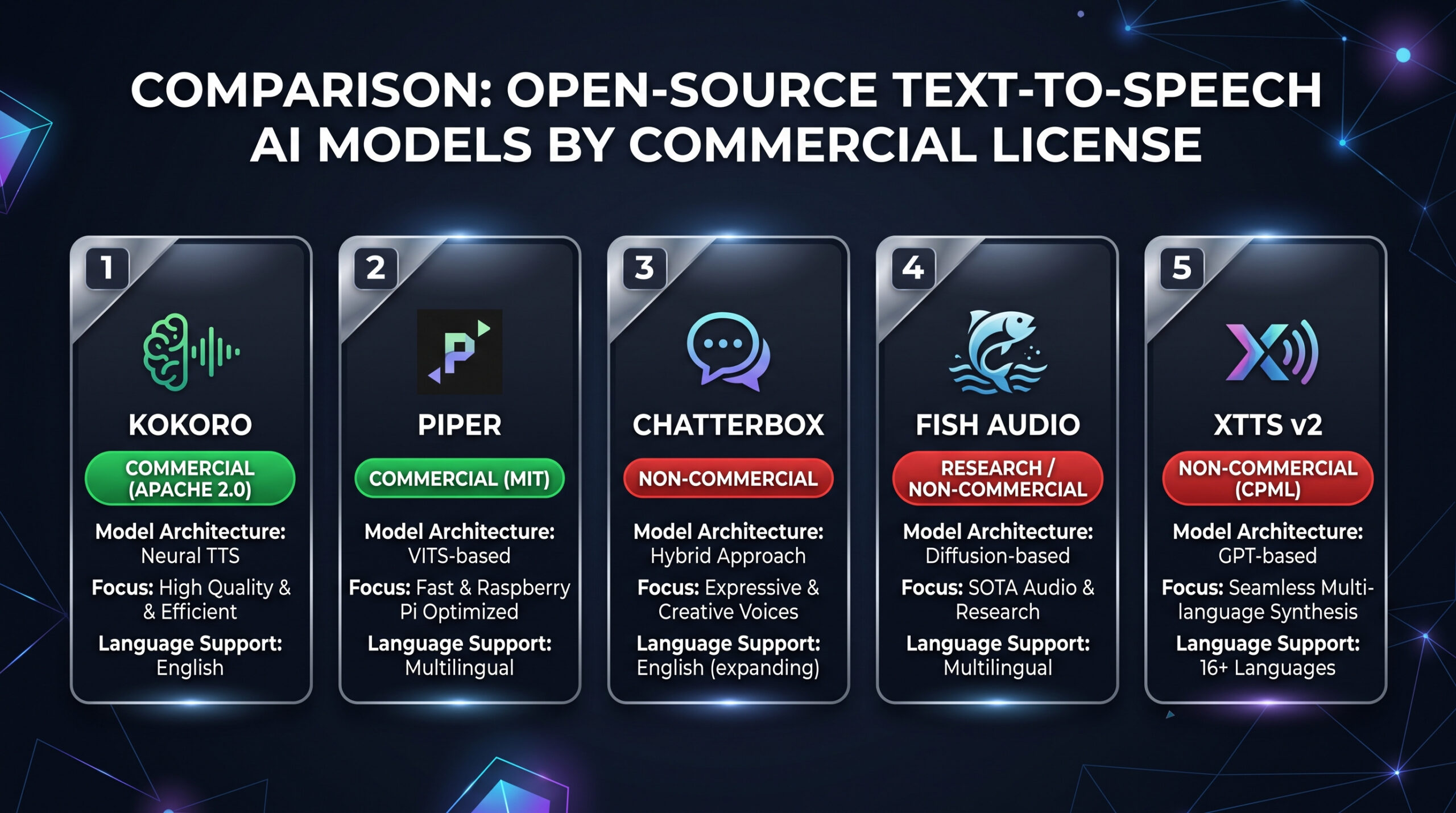
XTTS v2 appears on almost every list of free ElevenLabs alternatives. It’s multilingual, it clones a voice from about six seconds of audio, and thousands of people have built workflows around it.
Its weights are also under the Coqui Public Model License, which permits non-commercial use only and Coqui, the company behind it, shut down in January 2024.
There is nobody left to grant a commercial license. A request to relicense the weights permissively before the shutdown reportedly went unanswered. The canonical license URL now returns a 404 error.
So the model is permanently non-commercial, with no path to change that, and it’s still routinely recommended to creators who plan to monetize what they make with it.
That’s the problem with how this category usually gets covered. Sound quality is close to a solved problem now several open models beat ElevenLabs in blind listening tests. What actually separates these tools in 2026 is licensing, and that’s the framework this comparison uses.
📌 License terms here come from model cards and repositories rather than from roundup articles, because the roundups contradict each other — noted below where they do. Quality claims are attributed to whoever measured them, since several of the most-quoted figures in this space come from the companies that make the models. Licences change and models get relicensed, so verify on the source repository before building anything commercial.
🔗For paid options instead, here’s [https://aiflohub.com/elevenlabs-vs-murf-ai-which-ai-voice-actually-fits-faceless-youtube-in-2026/]
First, the consent question
This belongs near the top rather than buried, because it’s the part with real consequences.
Cloning your own voice is fine. Cloning someone else’s without permission is not.
That covers the obvious cases celebrity impersonation, fake endorsements, making it sound like someone said something they never said. It also covers less obvious ones: cloning a friend’s voice as a joke, using a creator’s voice because their delivery works well, or pulling a sample from a podcast.
Depending on jurisdiction, unauthorized voice cloning can involve impersonation law, publicity rights, or fraud, and it breaches the terms of most platforms. Several countries tightened rules specifically around synthetic voice in the last two years.
The workable rule: use your own voice, a voice you have written permission for, or a synthetic voice the tool supplies. Every option below works fine under that.
Some tools build safeguards in Chatterbox watermarks its output with a traceable signal called PerTh, so generated audio can later be identified as synthetic. That’s worth treating as a feature rather than a limitation.
1. Chatterbox: the strongest free cloner for commercial work
License: MIT. Commercial use permitted.
Chatterbox comes from Resemble AI. It’s roughly a 0.5B parameter model and performs zero-shot cloning from around five seconds of reference audio.
The widely-quoted claim is that it beats ElevenLabs in blind listening tests, with reported preference figures around 63.8% and 65.3%.
That figure needs context. The blind study was run by Resemble AI the company that makes Chatterbox. Vendor-run benchmarks reliably favour the vendor. Independent sources do consistently place Chatterbox at or near the top of the open-source field, so the direction is probably right, but the specific number isn’t neutral evidence.
The license is what makes it the standout. MIT permits use, modification, distribution, sublicensing and sale, provided the license notice is preserved. Anything generated with it can be monetized without further permission.
Requirements and caveats: a GPU is needed. Language support is unclear from public sources both “English only” and “23 languages” appear for different versions, so the current model card is the only reliable answer. All output carries the PerTh watermark.
Suits: creators who need cloning with clean commercial rights and can manage a local install.
2. Fish Audio : the most generous hosted free tier
License: contested. This section matters.
Fish Audio is the option requiring no local setup. Its hosted service has a free tier reported at around 8,000 credits per month including voice cloning, which appears to be the most generous free allowance from a top-tier model. Cloning works from roughly 10 to 30 seconds of reference audio.
Quality is competitive Fish Audio S2 places at or near the top of several public benchmarks. API pricing is far below ElevenLabs, with one comparison putting it at roughly $15 per million characters against ElevenLabs’ approximately $165.
The licensing picture is genuinely unclear. Sources published in 2026 state all of the following:
- Fish Speech S2 was open-sourced in March 2026 under Apache 2.0
- Fish Audio weights are CC-BY-NC (non-commercial)
- Open Fish Speech is CC-BY-NC-SA-4.0
- Fish Audio S2 Pro requires a paid commercial license for production use
These may all be describing different model versions, which would explain the spread but that’s an inference, not a confirmed explanation. Anyone planning commercial use should check the license for the specific model or plan directly on Fish Audio’s own site rather than relying on any third-party summary.
The lower-risk route is the hosted service on a paid plan, where commercial terms are typically stated clearly which is exactly what the free open weights lack.
Suits: people who want strong quality with no local setup and will verify terms before publishing.
3. Kokoro : the best free option that doesn’t clone
License: Apache 2.0. Commercial use permitted.
Kokoro doesn’t do voice cloning. It’s fixed-voice text-to-speech. It’s included here because for a significant share of people searching for free voice cloning, it’s the more useful answer.
At 82 million parameters around 300MB on disk it runs on a plain CPU. No GPU, no CUDA, no NVIDIA dependency. Reports have it running on a Raspberry Pi.
Despite the size it topped the TTS Arena in its class and posts a mean opinion score around 4.2 out of 5. It offers roughly 54 voices across 8 languages, with English the strongest.
The reason it belongs on this list: many people looking for “free voice cloning” don’t actually need cloning. They need a consistent, natural narrator voice for videos and have assumed cloning is the route to one. Kokoro delivers most of that outcome with no hardware requirement, no consent complications, and a permissive license.
Suits: narration, faceless video voice-over, accessibility tools, and any project on modest hardware.
4. Piper : lightweight and offline
License: changed recently check which version you’re using.
Piper is the low-resource option. Small, fast, offline-capable, and designed for edge devices. Output is noticeably more synthetic than the others here, but it’s near-instant and runs comfortably on very modest hardware.
The licensing detail that catches people: the original rhasspy/piper repository was MIT-licensed but was archived in October 2025. Active development moved to a fork, OHF-Voice/piper1-gpl, licensed under GPL-3.0.
GPL-3.0 permits commercial use but is copyleft, which matters if the code is being embedded inside closed-source software. For generating audio files to use in videos, it has no practical effect. The older MIT weights and voices remain usable.
Suits: offline use, embedded and accessibility projects, and situations where speed and hardware constraints outweigh naturalness.
5. XTTS v2 : widely recommended, commercially unusable
License: Coqui Public Model License. Non-commercial, permanently.
Listed last deliberately, because it appears on nearly every comparable list and the license situation is rarely mentioned.
The model itself remains capable multilingual, cloning from around six seconds, with a large installed base, extensive documentation and plenty of community tutorials. For personal projects with no revenue attached, it’s usable and well-supported.
But the weights are non-commercial, Coqui folded in January 2024, and no entity remains that can issue a commercial license. The license page itself is dead.
The practical position: fine for personal and hobby use, unusable for anything monetized, and permanently so.
The same restriction applies to F5-TTS, whose weights are also CC-BY-NC.
Quick comparison
| Tool | Licence | Commercial use | Clones voices | Needs a GPU |
|---|---|---|---|---|
| Chatterbox | MIT | Yes | Yes (~5s) | Yes |
| Fish Audio | Contested — verify | Depends on model/plan | Yes (~10–30s) | No (hosted) |
| Kokoro | Apache 2.0 | Yes | No | No (CPU) |
| Piper | GPL-3.0 (active fork) | Yes, copyleft | No | No |
| XTTS v2 | Coqui CPML | No | Yes (~6s) | Yes |
How to choose, in order
Step 1 — Establish whether cloning is actually needed. A consistent narrator voice doesn’t require cloning. If that’s the requirement, Kokoro resolves it immediately and removes both the hardware barrier and the consent complications. This eliminates the problem entirely for a large share of people.
Step 2 — Determine whether the output will be monetized. Personal projects with no revenue can use anything here, XTTS v2 included. Anything earning money including monetized video narrows the field to MIT and Apache-licensed models, or a paid hosted plan with stated commercial terms.
Step 3 — Check available hardware. No dedicated GPU rules out Chatterbox and XTTS v2, leaving Kokoro locally or a hosted service such as Fish Audio.
Step 4 — Test on a real script, not the demo text. Demo scripts are selected to show a model at its best. Running 200 words of the actual intended content, listened to on a phone speaker rather than headphones, gives a far more accurate impression most audiences will hear it that way.
Step 5 — Record the license terms. Screenshot the license and note the model version and date. If commercial rights are ever questioned, a dated record of the terms in force is far stronger evidence than a recollection of what a blog post said.
Common mistakes
Treating “open source” as “free for commercial use.” CC-BY-NC models are open in the sense that the weights are downloadable and closed in the sense that matters to anyone earning revenue.
Accepting vendor benchmarks as independent. Several of the most-cited quality figures in this category were produced by the companies selling the models.
Copying license claims from roundup articles. Licences get changed, repositories get archived, companies shut down. The repository is the only reliable source.
Cloning a voice without rights to it. The tools make this trivially easy, which is exactly why the responsibility sits with the user.
Assuming hosted free tiers permit commercial use. ElevenLabs’ own free plan is non-commercial, and most competitors follow the same pattern. Free tiers are generally for evaluation, not publication.
Underestimating setup cost. Free open-source models still require a GPU, an installation, and time. Often worthwhile but not zero.
🔗 Here is complete guide to best ai voice for faceless video [https://aiflohub.com/elevenlabs-vs-murf-ai-which-ai-voice-actually-fits-faceless-youtube-in-2026/]
Where this leaves things
For narration alone, Kokoro is the cleanest answer: permissive license, runs on a laptop, and it sidesteps the cloning question entirely.
For cloning a voice you have rights to, with a GPU available, Chatterbox has the strongest combination of quality and license terms in the free tier.
For no setup at all, Fish Audio’s hosted service is the practical route, provided the commercial terms on the chosen plan are confirmed first.
And any comparison that recommends XTTS v2 to creators without mentioning its license has skipped the check that matters most. The quality gap with ElevenLabs has largely closed. The licensing gap hasn’t, and that’s the one carrying real cost.
FAQ
What’s the best free ElevenLabs alternative for commercial use?
Chatterbox under MIT, for local cloning with a GPU. Kokoro under Apache 2.0, for narration without cloning, running on a CPU.
Can free voice cloning tools be used on a monetized YouTube channel?
Only where the license permits commercial use. MIT and Apache 2.0 models qualify. CC-BY-NC models including XTTS v2 and F5-TTS weights do not, and ElevenLabs’ own free plan is non-commercial.
Which tool clones a voice from the shortest sample?
Reported figures place several in the five-to-ten-second range: Chatterbox around five seconds, XTTS v2 around six, Fish Audio around ten to thirty. Shorter reference samples generally produce lower fidelity.
Is a GPU required?
For Chatterbox and XTTS v2, yes. Kokoro and Piper run on a CPU, with Kokoro reportedly running on a Raspberry Pi. Hosted services such as Fish Audio need no local hardware.
Is cloning someone else’s voice legal?
Not without permission. Depending on jurisdiction it can involve impersonation, publicity rights or fraud law, and it breaches most platform terms.
Why do sources disagree about licences?
Because models get relicensed, forks adopt different terms, and companies close. The originating repository or model card is the only dependable reference.
Leave a Reply