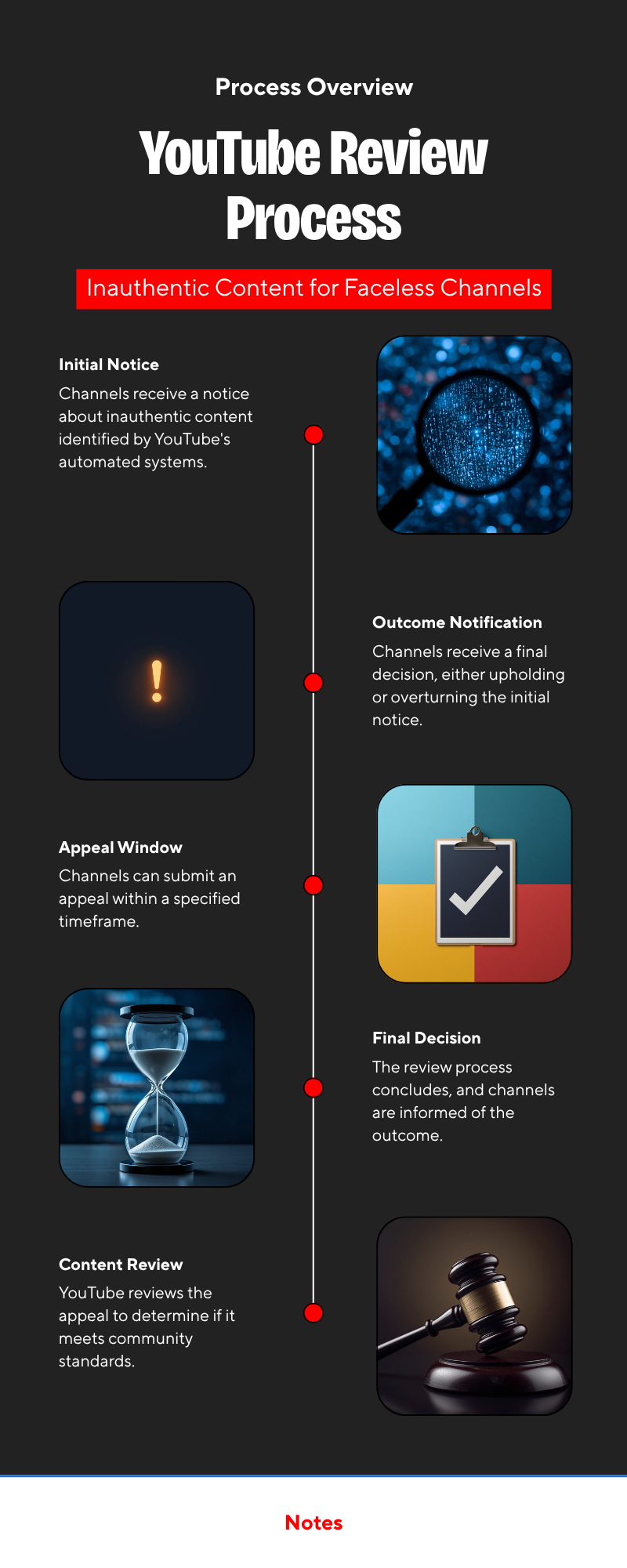
The thing that surprised me most while researching this wasn’t the policy. It was the deadlines.
I’d been reading through YouTube’s monetization help pages properly — not the summaries, the actual pages — and I kept hitting numbers nobody mentions in the panic videos. Seven days here. Twenty-one days there. Fourteen days for a response. Ninety days before you can reapply.
Those numbers decide outcomes. A creator who reads their notification carefully and responds inside the window has a completely different experience from one who spends the first week posting on Reddit asking what happened.
And almost every article on this policy stops at “don’t make templated content” without explaining what a review actually looks at, or what you do when the email arrives.
So that’s what this is. Not “is faceless dead” — I covered that separately. This is the mechanics.
“If you’re here because you saw the panic and just want to know whether faceless still works: [I answered that separately here].” → https://aiflohub.com/can-faceless-youtube-channels-still-monetize-in-2026/.
1- The policy is a monetization rule, not a content rule
This distinction confuses a lot of people, and it changes what’s at stake.
Inauthentic content is a YouTube Partner Program policy. It governs whether you can earn, not whether your videos can exist. A channel can fall foul of it, keep every video up, and simply lose monetization.
That’s a separate system from Community Guidelines strikes, which are about content staying on the platform at all. They can intersect — if you break both, you get both consequences — but they’re reviewed separately and appealed separately.
Practically: if you get a notice, the first thing to establish is which system it came from. A monetization decision is appealable through a specific route. A termination from Community Guidelines strikes is a different, harder path, and the monetization appeal won’t touch it.
People waste their appeal window arguing the wrong case. Read the notice before you write anything.
2- What reviewers actually look at
Here’s the part I found most useful, because it reframes the whole problem.
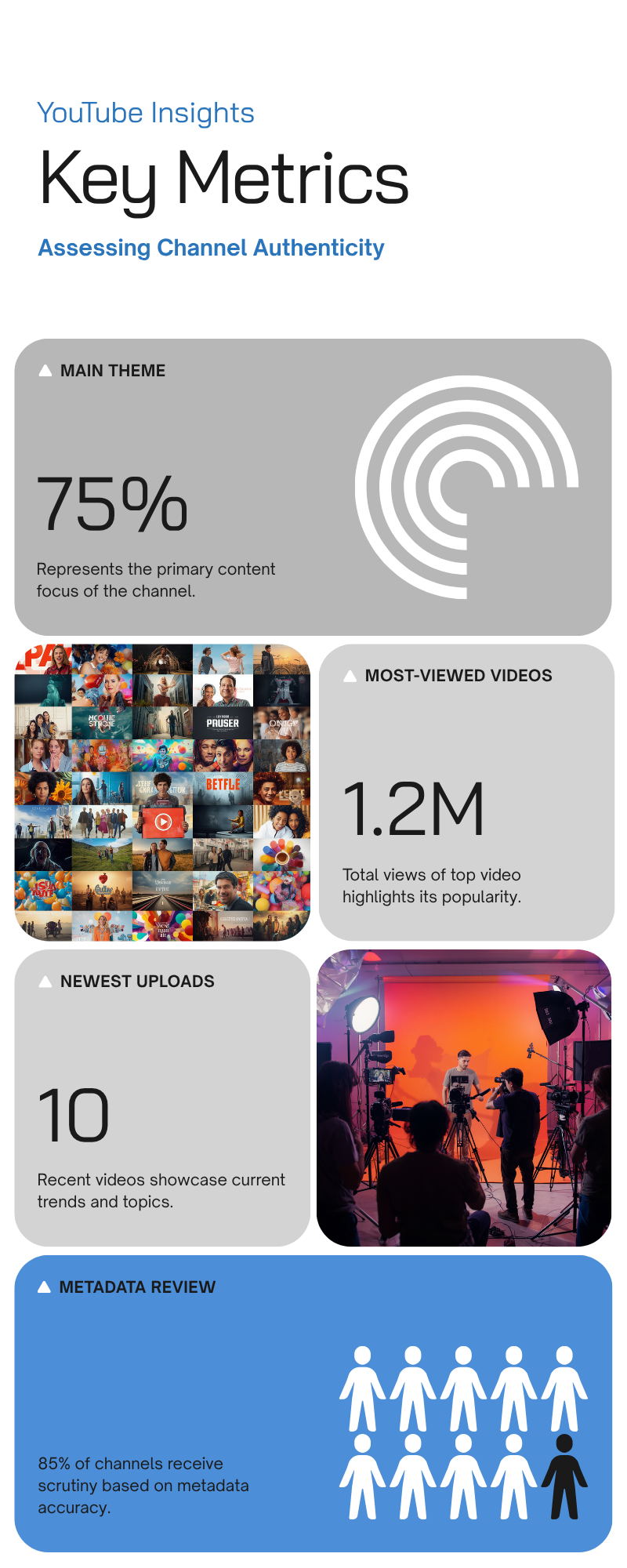
Reviews under this policy assess the channel as a whole, not individual videos in isolation. Specifically, they look at your channel’s main theme, your most-viewed videos, your newest uploads, and your metadata — titles, descriptions, thumbnails, tags.
Two things follow from that.
One good video doesn’t save you, and one weak video doesn’t sink you. The unit of judgement is the pattern.
Your back catalogue counts. Videos you made two years ago, when you were following whatever template was popular then, are part of what gets assessed. If you’ve improved, your old uploads may still be dragging the average down.
Reviews run on a combination of automated systems and human reviewers. The automated layer is why format matters so much — it fires on production patterns and volume signals, not on whether your script was thoughtful. A human reading your work might see originality that a pattern detector doesn’t.
3- Three ways to fail, and one that’s underrated
YouTube’s July 2026 clarification named three categories. Quick version, since I covered these in depth in the other post:
Generic, repetitive, or template-based. The content-farm bucket. Same structure re-rendered with different nouns.
Off-putting or distressing. Emotionally manipulative formulas with no payoff.
AI personas presenting as real. Fabricated authorities delivering information, especially on news, health and finance.
The underrated one is the first, and specifically this: a channel producing dozens of videos with identical list formats on different topics can fall into the generic category even when every video is originally written. Original wording is not the same as original format. That’s the trap for honest faceless creators, and it’s the one I’d worry about if I were building a channel now.
There’s also a fourth failure mode people forget, because it sits in a different policy: reused content — other people’s material with no meaningful original value added. Reading news articles aloud verbatim fails here even if your voice, editing and channel are entirely your own.
“I broke down all three categories with examples in [https://aiflohub.com/can-faceless-youtube-channels-still-monetize-in-2026/].”
4- The disclosure rule and its three-strike sequence
Separate obligation, easy to get wrong in either direction.
You disclose realistic synthetic or altered content — AI-generated footage that could pass as real, or making it appear a real person said or did something they didn’t. You toggle “altered or synthetic content” in YouTube Studio at upload.
You don’t need it for a synthetic narrator reading your own script over stock footage. That’s the most common faceless setup and it generally doesn’t trigger the requirement.
Failing to disclose when you should have carries an escalating sequence: warning, then a monetization suspension, then removal from the Partner Program.
YouTube has stated the disclosure doesn’t affect ranking. Given that, the risk calculation is one-sided — if you’re genuinely unsure whether your visuals count as realistic, toggle it.
5- If you get a notice: the timeline that decides everything
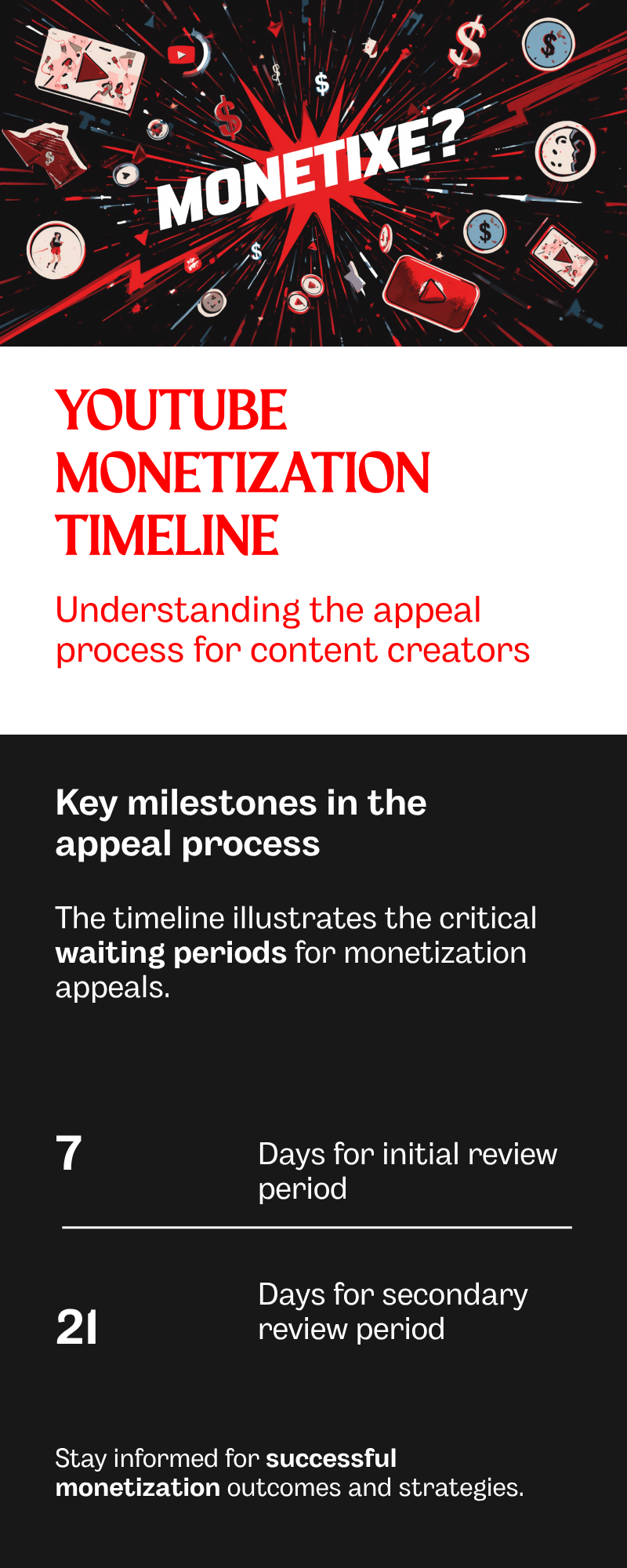
These come from YouTube’s own help documentation. Verify them in your notice, because your specific situation governs.
Scenario A — “scheduled for suspension” warning
Sometimes YouTube tells you a suspension is coming and invites an appeal first.
You get 7 days. Submit inside that window and the scheduled suspension is paused while your appeal is reviewed. Teams respond within 14 days.
Miss the 7 days and the suspension goes through automatically.
This is the best position to be in and the easiest one to waste. Seven days disappears fast if you spend three of them panicking.
Scenario B — already suspended, or your YPP application was rejected
You get 21 days to appeal, regardless of how many times you’ve applied before.
Teams respond within 14 days. If the appeal succeeds, approval or re-approval typically lands within 30 days.
If it’s rejected, you cannot appeal again — but you can reapply to YPP 90 days after the suspension or rejection date.
The dates to write down
The moment a notice arrives, put three things in your calendar: your appeal deadline, the date 14 days out when you should expect a response, and your 90-day reapply date if it goes badly.
Date-stamp the notice. Everything else runs off that.
6- How to write an appeal that isn’t instantly rejected
The single most common mistake is an emotional appeal. “My content IS original, please reconsider” is a message with no evidence in it, and it gets treated accordingly.
What works is documentation.
Step 1 — Read the notice and name the exact policy. It tells you which policy your channel breached. Your appeal should address that policy specifically, not originality in general.
Step 2 — Acknowledge the concern before defending yourself. If your format genuinely resembles the pattern the policy targets, saying so first makes everything after it more credible. Reviewers see hundreds of appeals insisting nothing is wrong.
Step 3 — Show your process, not your intentions. You don’t need to show your face. You need to show human work. Your research sources. Your script’s version history — Google Docs keeps this automatically, which is a genuinely good reason to draft there. Your voice tool and its commercial licence. Your edit timeline.
This is the part most creators skip and it’s the part that actually distinguishes you from an automated channel.
Step 4 — List concrete changes, with specifics. Not “I’ll improve quality.” Instead: which videos you removed, what changed in your format, how your upload schedule is different, what you added that a template couldn’t produce.
Step 5 — Keep it tight. A few hundred words of specifics beats a long emotional letter every time.
Step 6 — Submit through the right route. From your monetization status page in YouTube Studio, using the appeal type your notice specifies. Contacting general support when a video appeal is required is a common and costly error — it can burn your window.
Step 7 — Watch the dashboard. Updates and requests for further information appear there. Missing one means missing a chance to strengthen your case.
7- Build your evidence before you need it
This is the actual lesson, and it costs you nothing today.
Everything a strong appeal needs is trivial to produce while you work and nearly impossible to reconstruct afterwards. So build the habit now:
Draft scripts in Google Docs. Version history becomes a timestamped record of a human writing. Free, automatic, and one of the most convincing things you can show.
Keep a research file per video. Sources, links, notes. Ten seconds per video, and it’s proof of original input.
Save your tool licence receipts. ElevenLabs, Murf, whatever you use — the paid tier that grants commercial rights. Screenshot the plan page.
Keep project files, not just exports. A CapCut or DaVinci Resolve timeline with dozens of cuts is evidence of editing decisions. A single unbroken clip is not.
Note what’s original in each video. One line per upload: the take, the comparison, the correction. If you can’t write that line, that’s a warning sign before anyone reviews you.
I’d treat this as insurance rather than paranoia. Automated enforcement produces false positives, and reporting on the January 2026 wave documented creators with years of original voiceover work facing reviews because their format resembled the channels being targeted. Being genuinely original doesn’t guarantee you’re never flagged. Being able to demonstrate it changes what happens next.
8- Mistakes that make things worse
Deleting everything in a panic. Removing videos wholesale destroys the evidence of your work and doesn’t fix a format problem. Remove specific low-value uploads for a specific reason.
Uploading more during a review. Adding more of the same format while reviewers are assessing your channel-wide pattern is the opposite of helpful.
Appealing a channel that genuinely does re-read other people’s articles. If the notice is accurate, an appeal won’t fix it. Remediate, then reapply.
Missing the window while researching. Forum threads will still be there after you file. The 7 or 21 days won’t.
Treating rejection as final. A rejected appeal isn’t a permanent ban. There’s a 90-day reapply path, and the interim is meant to be used for actually changing the format rather than waiting it out.
Assuming original wording is enough. It isn’t. Format variation is what the generic bucket measures.
9- What I’d actually take from all this
The policy isn’t hostile to faceless creators. It’s hostile to interchangeable content, and faceless production just happens to make interchangeable content cheap to produce.
Which means the compliance work and the quality work are the same work. Vary your formats. Put a position in your scripts. Keep the paper trail. Read your notices carefully if one arrives, and respond inside the window with evidence rather than argument.
None of that is a trick. It’s mostly just doing the thing properly and being able to prove you did — which, when the reviewer might be an automated system that can’t tell the difference on its own, turns out to matter quite a lot.
🔗 https://aiflohub.com/elevenlabs-vs-murf-ai-which-ai-voice-actually-fits-faceless-youtube-in-2026/
FAQ
How long do I have to appeal a YouTube monetization suspension?
21 days from the suspension or rejection, or 7 days if you’ve received a “scheduled for suspension” notice and want to appeal before it takes effect. YouTube responds within 14 days.
What happens if my appeal is rejected?
You can’t appeal again, but you can reapply to the Partner Program 90 days after the suspension or rejection date. Use that time to change the format, not to keep uploading the same thing.
Does the inauthentic content policy remove my videos?
No. It’s a monetization policy — a channel can lose monetization and keep every video published. Video removal comes from Community Guidelines, which is a separate system with a separate appeal route.
Does YouTube review individual videos or the whole channel?
The whole channel — main theme, most-viewed videos, newest uploads, and metadata. One strong video won’t offset a repetitive pattern across the channel.
Can original scripts still be flagged as generic?
Yes. A channel making dozens of videos in an identical format can fall into the generic category even when every script is written from scratch. Format variation matters as much as wording.
Do I need to show my face to appeal successfully?
No. You need to show human work — research sources, script version history, licensed tools, edit timelines. Documentation of process, not identity.
Leave a Reply